Das Wichtigste in Kürze
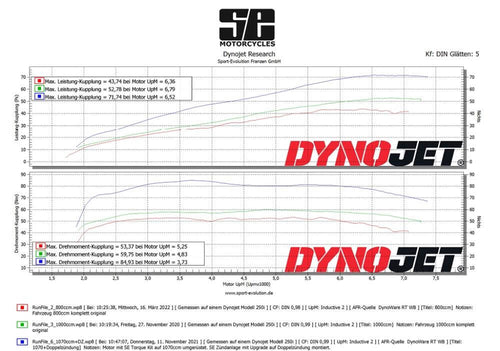
- Original R100 (1000 cc): in reality usually 53–54 hp, not 60
- 1000cc aftermarket piston: same design, 480 instead of 537 g – revs more freely, but no extra power
- More power is created through compression, not through piston weight
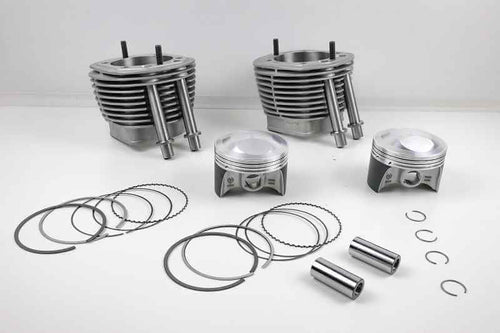
- SE-1070cc (98 mm): modern piston rings, modified piston crown, manufactured by Pistal
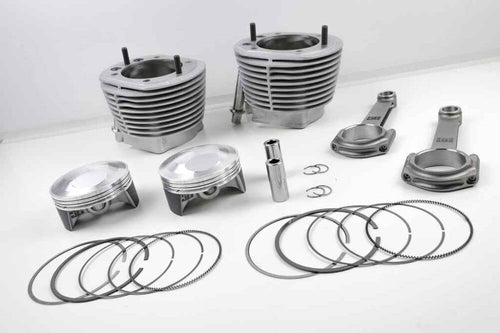
- Short piston (360 g) + Carrillo connecting rod: almost 300 g lighter per side – more responsive
- Housing with 97 mm bore: bore out to 100 mm
- From 800 to 1070: adjust combustion chamber to 98 mm
- Recommendation: 1070 + dual ignition ≈ 75–80 hp / approx. 85 Nm
Fake news – I just have to call it that. Over the last 14 days, I have been confronted with a rumor several times. At first, I didn't really take much notice; some things are just hotly debated, it quickly gains momentum, and then customers call. But yesterday someone was on the dyno, and that annoyed me. That's why I'm addressing the topic.
The rumor: More horsepower from a 1000cc aftermarket piston?
The rumor goes: If you mount a 1000cc cylinder from a very well-known aftermarket manufacturer on your 1000cc BMW, you will have more power than with the original BMW cylinder. And I'll say it right away: The material from this manufacturer is very, very good – we source the 1000cc and 860cc kits from them ourselves.
So the customer is on the dyno and says: "The 1000cc BMW has 60 hp, so with this cylinder I must have 70 now." Anyone who follows our channel knows: Our dyno has been running since 1991, three or four times a week. We have a huge treasure trove of data. And most 1000cc BMWs don't have 60 hp, but rather 53, 54 hp. He expected 70 and had 51 – and then the discussion started that we must have done something wrong. Where does that come from? "He said so, and he tunes all the BMWs in the world." I know the people in the scene – but he doesn't have a dyno and doesn't build engines. And I have never heard this statement from the piston manufacturer themselves.
The fact check: Original piston vs. aftermarket piston
So I put the two pistons side by side: on the left a used piston from an original 1000cc BMW, on the right the aftermarket piston. In terms of design, it is exactly the same piston – pockets, everything is the same. There is no small engine inside and no molecular drive.
The only difference: It is lighter. The original piston weighs 537 g, the aftermarket piston 480 g. Lower mass accelerates faster – the engine revs up more freely because it has less weight to accelerate in the crank assembly. But that doesn't bring more power. Anyone who has dealt with tuning knows: For 10, 12, 14% more power, you have to do more than just swap a piston.
What about the piston would bring more power? Primarily the compression. If I build the piston crown higher, I get a higher compression ratio, higher mean pressure – and thus more torque and power.
Our own 1070cc piston: What we do differently
There are 800cc, 1000cc, and in the last 30, 40 years various kits with 1040, 1050, and 1070 cubic centimeters. The 1070cc is also available from this manufacturer, but we have our own. Not because we are the smartest people in the nation – we use the 1000cc piston too. But almost all our vehicles and concept bikes get 1070cc. Economic efficiency and availability play a role here: If we have control over the production ourselves, we can react better.
And since we are making our own, we also wanted to improve something:
- Piston rings: The BMW engines still have piston rings based on 60s and 70s technology. We install modern, significantly narrower piston rings, as they are found in all vehicles today. The sealing is better, but above all, friction losses are reduced – and friction costs power.
- Piston crown: We made the hump a bit higher and changed the squish band to get more out of it in terms of combustion technology.
- Production: The design is ours, the pistons are manufactured by Pistal in Italy – one of the best piston manufacturers in the world. We have already had very good experiences with them in the Superbike World Championship.
Short piston with long connecting rod – or original connecting rod?
Both variants have 1070cc, i.e., 98 mm bore.
Variant 1: short piston with longer Carrillo H-beam connecting rod. So that I can use the short piston, I need a longer connecting rod – otherwise a piece would be missing, and there would be no more compression. Why all this? Significantly less friction surface, better tilting moment – and above all weight:
- Piston: original 537 g → short piston 360 g
- Connecting rod: original 580 g → Carrillo 470 g
- Together almost 300 g less per side
The engine revs up faster, the acceleration gets better. Disadvantage? A BMW engine has a certain composure. You drive it at 1,000 rpm, hit the gas, and it starts moving very smoothly – also because of the constant-depression carburetors. If you make the crank assembly light and perhaps combine that with flat-slide carburetors, it becomes much more aggressive. One side of the community loves that: hit the gas, it pulls immediately and pushes you back. The other says: "I ride comfortably through the Eifel with a tank bag and my wife; if it gets too hectic, I don't like it." That's why I always ask customers what they intend to do with the motorcycle.
Variant 2: 1070cc for the original connecting rod. The piston is higher and, at 480 g, about 120 g heavier than the short one; it is driven with the heavy original connecting rod. It is still lighter than the original, but the good-natured character is preserved. In terms of character, there is then no difference.
When does the 1070cc fit into the engine housing?
The piston dips a bit into the engine housing at the bottom, and the housings have different bores:
- 100 mm (latest engines): everything is safe
- 99 mm (I think model years 1980–84): everything is safe with the short piston
- 97 mm (old vehicles): not safe at all. Then the engine has to be taken apart and we bore out the housing to 100 mm. The stud spacing for cylinders and heads is the same, so there is no disadvantage in terms of strength.
And the cylinder head? Adjusting the squish band
A very big topic: What happens to the cylinder head? 1000cc has a 94 mm bore, 1070 has 98 mm – 4 mm in diameter, 2 mm in radius. So that not everyone has to send in their head, we have a small step of exactly these 2 mm on the piston to compensate for the combustion chamber being too small.
The squeeze area – the area where the mixture is squeezed and the head comes very close to the piston – is run much tighter in modern engines. Back then, the distances were very large due to fuel and material experience. Even if I combine a 1070cc (98 mm) with the cylinder head of an R80 (84.8 mm), this does not lead to a conflict. That changes if a head is reworked and planed down.
Our recommendation:
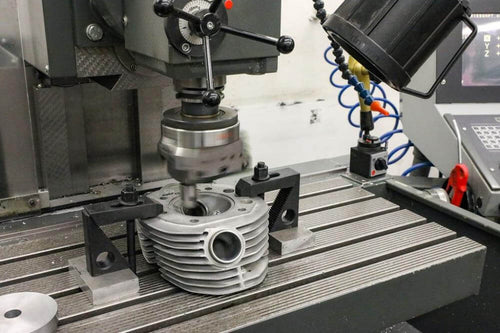
- From 800 to 1070: Definitely adjust the combustion chambers to 98 mm. The head goes on the milling machine, the squish band is machined at the same angle as the piston. Costs us something around 80, 90 euros.
- From 1000 to 1070: If you want it one hundred percent perfect, you can do it – but only if the head is being reworked anyway. I wouldn't take it apart and send it away just for that.
And then there is another bad habit: pistons where a step was simply turned into the piston crown for the jump from 800 to 1000. I can only say: Congratulations. Anyone who has dealt a little with squish clearance and compression will have a breakdown. If we get something like that in, we turn away the step, make a flat surface, and adjust the head. If you have everything apart anyway, it shouldn't fail because of 90 euros.
What does it bring? 1070 plus dual ignition
We have published the exact power curves – 800cc, 1000cc, 1070cc, 1070cc with camshaft and dual ignition – on our website.
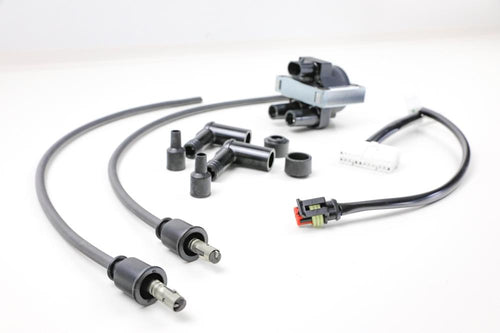
Regarding dual ignition: At 1000cc, it definitely makes the engine run smoother. You get the real power jump together with 1070cc. 1070cc with versus without dual ignition: around 8, 9 Newton meters difference, because we can run higher compression. The ignition timing is still significantly lower, about 10 degrees less – the load on the engine decreases, efficiency increases, and in the end, more power with less consumption.
If someone asks me what they absolutely must do for more power, I always say: 1070 and dual ignition. Everything else on top is the icing on the cake. Then you have – measured on our dyno, not just told – about 75 to 80 hp and around 85 Newton meters. After ten meters, you notice how it pulls.
A dyno cannot be cheated
At the beginning, I was a bit harsh with the fake news. But on the dyno, all truths come to light. I understand that customers get annoyed when they have been sold something, come here beaming with joy, and are looking forward to the best diagram for the regulars' table – and then it doesn't turn out that way. Sometimes I also say: Just ride it first. If they come back beaming and say "Feels good," then leave it at that. But when we do development and make concrete statements about products, we have to provide facts. How else are you supposed to develop if you let yourself be fed by rumors and feelings?