Das Wichtigste in Kürze
- Foreign upside-down fork: springs and damping usually 40–50% too stiff for a boxer
- USD forks can hardly be shortened – check length beforehand
- R65 to 860 cc with machined heads, camshaft, and flat-slide carburetors: over 60 hp
- R80/R100 as a base provides more power for the same effort
- Exhaust, side stand, and footrests must fit together
- Limit suspension travel so that the rear does not hit the fender
Today I'm introducing a customer build. Usually, people send us pictures of their bikes, and I give my assessment. But for this motorcycle, we finished quite a bit of it ourselves – and because it's so out of the ordinary, I'm showing it to you live.
When the motorcycle came to us, the rear conversion, tank, and fork were already done. This is often the case: stylistically, many things are put together, but in the end, it also has to function. Especially when it comes to chassis geometry, some things are seen too simply when the basic knowledge is missing.
The upside-down fork
Taking a fork from an existing vehicle makes economic sense and makes registration easier. If you take the fork from a superbike, the component itself is tested. Then the inspector just has to confirm that the overall package works: How does it brake, how does it handle, are the height and offset correct, is the motorcycle safe? With us, such things can usually be registered.
The downside: A superbike is designed to be braked into a hairpin turn at 250 km/h – with full deceleration. You don't have that in a motorcycle like this. The spring rates are therefore usually 40 to 50% too stiff.
- Springs replaced: We disassembled the fork and adjusted the spring rates.
- Damping adjusted: The damping is tuned to the original spring. If you only change the spring, the damping is still too stiff.
- Pay attention to the length: Upside-down forks cannot be shortened as easily as conventional ones. The suspension travel is short anyway – if you take out 50 mm, there is hardly anything left. Anyone planning something like this should check how long the fork is beforehand. If the motorcycle stands too high at the front, it doesn't look good and also rides worse because there is a lack of front-end load.
The engine: R65 with 860 cc
The question often arises: R65 or R80 as a base? Stylistically, it doesn't matter, and you might get an R65 a bit cheaper. But an original R65 with 50 or even just 27 hp is simply less fun – it's not about driving fast, but about torque.
If you want to tune an R65, you have to put a lot into motion to get close to an R100 – with similar effort. An R100 with 1070 cc and a different camshaft ends up at around 80 hp and 90 Nm. We brought this R65 to 860 cc:
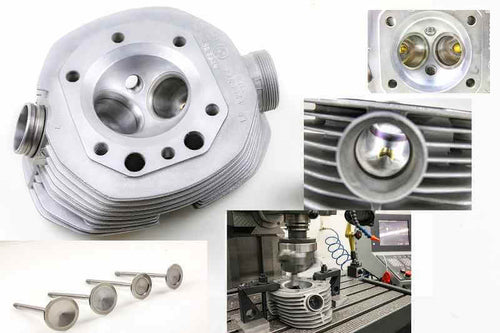
- Cylinder heads machined, exhaust ports bored out to 38 mm for larger exhaust systems
- Different camshaft, lightened flywheel
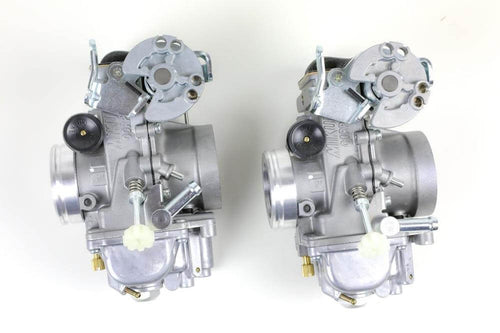
- Flat-slide carburetors with open filters – registered due to the year of manufacture
- Engine completely black coated
The result was just over 60 hp – one of the strongest R65s we have ever built. A great engine, but still a difference to the R80 or R100.
Footrests, shock absorbers, license plate
We adapted the footrest system. In conversions, the exhaust, side stand, and footrests often collide: the brake lever hits the exhaust system, the side stand folds against the exhaust or sticks out too far. Especially with bobber systems, something often scrapes on the left at just 10° of lean angle – that's no fun.
We had the shock absorbers made especially for the vehicle and limited the suspension travel so that the rear frame does not hit the fender. We see this often: nice rear, original, much too soft shock absorber – first bump, dent in the fender.
The self-made license plate holder was much too slanted and had to be replaced. The new one has elongated holes so that the license plate can be adjusted to the prescribed angle.
Honda tank and electrics
A special feature is the adapted Honda tank. The challenge was the electrics underneath: when a motorcycle is very clean and there are no more covers, everything has to go under the tank – and with a narrow tunnel, that gets tight. Some customers say "that's quite simple." Then I say: Come by and show me.
With these customer videos, I don't want to judge whether I like a bike. It's about providing help: many have cool ideas, buy a tank here, a fork there – and then face the big realization. I want to pass on some basic knowledge from our projects. We also have hurdles that you can't see in the result.