Das Wichtigste in Kürze
- Do not touch the idle jet in 99% of cases
- Check original main jet (BMW: 150, 155, or 175 from the factory)
- Main jet 10 points larger, same manufacturer
- 1 hour on the country road, 25–100% throttle, all RPMs (markings on the throttle grip)
- Check spark plug color, if necessary 5 sizes back – when in doubt, go richer
- Mid-range via needle clip: higher = leaner, lower = richer
- It is more precise with a lambda meter
A technical topic we receive emails about every week: tuning carburetors. First, we need to distinguish between adjusting carburetors and tuning carburetors.
- Adjusting is simple workshop work: synchronizing throttle valves, setting the idle mixture via the mixture screws – the kind of thing done during an inspection.
- Tuning means: You have installed a different exhaust, a different air filter, a different cylinder kit – something technical has been changed. Then the engine's requirement profile no longer matches what the carburetors are delivering. The carburetor is, let's say, a dumb component: It has jets and jet needles through which fuel passes. It cannot think for itself.
Why we don't give "Just put a 160 in" answers
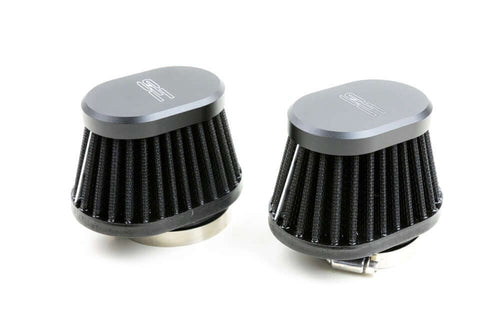
We sell exhaust systems and open filters, and every week emails arrive: "I bought the filters from you, which main jet should I put in?" I answer the emails, of course – but not that question. The reason is quite simple: The BMW is actually a simple motorcycle, but I have 650, 800, 1000, 1070 cc, short exhausts, 2-in-2 systems, open filters, old and new air filter housings, different camshafts. Working out something for every combination is beyond our scope, even for us.
On top of that: BMW installed different base configurations. There are carburetors with a 150 jet as standard, others with 155, some even with 175. If I just say "Put a 160 in" and the bike already has a 175 originally, plus open air filters, then the vehicle will run too lean – and damage will occur.
I am happy for anyone who comes to us for the dyno; we tune the motorcycle, and they ride off the lot happy. But I understand if that is too far for someone. That is why this is about the question: Can I tune a carburetor at home, without a performance dyno, using normal means? And right off the bat: Anyone who thinks they will get three tips, tune it on a Saturday between 8 and 9, and start a big Italy tour at 10 – it is not that simple.
The three systems in the BMW constant-depression carburetor
This is primarily about the BMW constant-depression carburetors (Bing), because that is the majority of our work. Basically, there are three systems:
- Idle system – idle jet plus mixture screw
- Main jet
- Jet needle with the vacuum piston
Idle system: Keep your hands off the jet
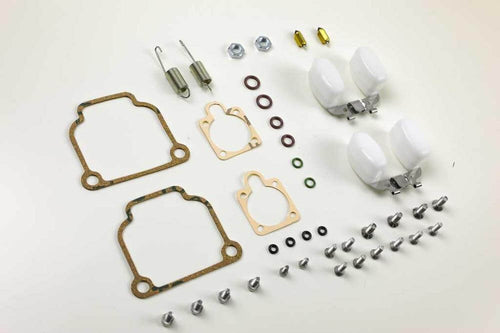
Why is a separate idle system needed? At idle, the throttle valve is only minimally open. That is not enough for the engine to draw fuel from the main system. That is why there are small holes at the throttle valve from which some fuel comes. The idle jets are in the 40, 45, 50 range – the main jets are more like 115, 120, 150, so much larger.
You will likely not need to touch the idle jet 99% of the time. The idle must be set via the screw, but it is generally never the case that you have to change the idle jet because of an exhaust or an open air filter.
Main jet and jet needle: How they interact
The fuel comes from below into the main jet, flows through the mixing tube into the channel, and that is where the jet needle with the vacuum piston sits. With the throttle grip, you only move the throttle valve – the piston moves via vacuum: The higher the RPM and the further the throttle is open, the higher the needle rises.
The jet needles are conical, thinner at the bottom, thicker at the top. The further the needle comes out, the larger the so-called annular gap becomes, and the more fuel flows. At 100%, the limitation is no longer the gap at the needle, but the opening of the main jet itself. You can say: The main jet affects the entire range from idle, the needle primarily the mid-range – half to three-quarters.
Step 1: Main jet – 10 points larger and off to the country road
This is how I would proceed: Check which main jet you have in there – let's say a 150 – and make it 10 points larger. Important: Stay with the same manufacturer. Mikuni, Dell'Orto, Bing – they all have different calibrations. If you have an original Bing 150, then take a Bing 160 next.
Then head out to the road – the old-fashioned way, based on spark plug color and running behavior. Best not in city traffic, but on the country road: drive for an hour between 25 and 100% throttle at all RPMs, try everything out.
Tip: How do you know what 25% is? Stick markings on your throttle grip. Give full throttle, mark it, half back, mark it, two more marks in between – then you have quarter, half, three-quarters, full throttle.
Take a spark plug wrench and an alternative jet with you. After the hour, take the plugs out – then you have an indication of whether the main jet fits reasonably well. If it is coal-black, go five sizes smaller, clean the plugs, and drive for another half hour. Smaller gets lighter, larger gets darker – that is how you calibrate it.
Spark plug color today: No longer as clear
With today's fuels, the spark plug color is no longer as clear as it used to be with leaded fuel, where it turned a nice deer-brown. From racing, I know engines that were specifically set slightly rich using lambda measurement and still had snow-white plugs after the race. So, white does not automatically mean "very dangerous." But: If you cannot measure precisely, orient yourself a bit richer.
for safety. The BMWs are relatively insensitive. In eight out of ten cases, you put on open filters, drive up and down the road, and say: It runs. That can still mean you are sacrificing performance – or that it is running too lean and you will eventually have engine damage.
Step 2: The mid-range via the jet needle
If the main jet is made larger, it often becomes too rich in the mid-range. In daily operation and city traffic, you then constantly have black plugs and high consumption – it doesn't have to be that way.
The jet needle is regulated by height, via clips on the needle:
- Move clip higher → needle sits lower → leaner
- Move clip lower → needle sits higher, the annular gap opens → richer
That is basically the whole trick.
How we do it today: Lambda measurement
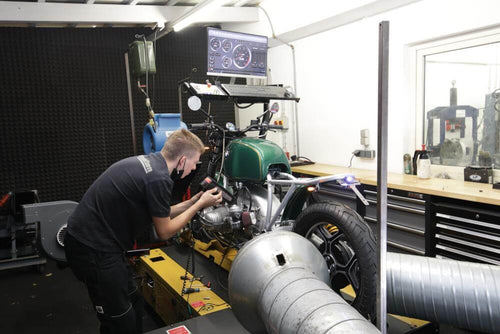
On the dyno, we work with a lambda sensor. Most people know them from cars. It measures the mixture composition, and you set the carburetors using these measured values. That is how it started for us back then, too: Sensor in, multimeter taped to the tank, paper and pen, over the highway, and constantly writing down which lambda at which RPM.
Today, you can buy this as a ready-made test device. Then you drive full throttle, half throttle, and see the mixture in the ranges – and don't have to puzzle for an hour whether the plug is black, brownish, or white.
A quick look back: We bought our first dyno in 1991 – there was no lambda measurement back then; we worked with CO testers that were actually intended for idle and not for a racing motorcycle at 12,000 RPM. And on the racetracks? You can't even tell this story, but the superbike was unloaded at the rest stop, 5 km full throttle, pull the clutch, engine off, and the spark plug color checked. Same with half throttle, three-quarters, and quarter throttle to separate the ranges.
Tinker yourself or have it done?
With the BMWs, it is not about a racing motorcycle and a Newton-meter plus/minus. It is about the mixture not being too lean – otherwise something breaks – and not too rich – otherwise you have sooty plugs, poor starting, and high consumption. Find a reasonable middle ground.
For those who say "I don't feel like it": Then bring it to us, it costs around 350 euros, then it is set and good. I am addressing people who enjoy figuring it out themselves. For them, it is a playground: How does it change with a different air filter, a different camshaft? Many of our customers don't modify to save money – but because they enjoy it.
We are happy to sell you exhaust systems and filters – but we don't want you to fall into the trap of having engine damage later because something ran too lean.