Das Wichtigste in Kürze
- Open filters: no extra power, mixture slightly leaner, float level becomes more sensitive
- Registration of open filters: up to model year 1988 with noise/power measurement, from 1989 only with exhaust emission report
- Rain: no problems with oiled filters
- Engine overhaul light: engine stays in, heads completely new, connecting rod bearing check
- Big overhaul: completely disassembled, blasted, package price incl. bearings, timing chain, gaskets
- Tires: never go below speed and load capacity, up to 140 mm width on BMW rims
Another "You ask Dietmar": I receive the questions bluntly and do not see them beforehand. This time, quite a few things centered around the same topics – open air filters, TÜV (technical inspection), engine overhaul, and tires.
Do open air filters provide more power on the BMW Boxer?
Heiko asks: As professionals, what do you say to the argument that the carburetor works suboptimally when there is disturbed laminar flow?
Laminar flow, those are parallel layers – we dealt with fluid dynamics very intensively during our racing days. I cannot see a connection to "suboptimal" here. I don't want to demonize it if someone says "That doesn't work" – it often depends on the other conditions in the vehicle. In fairness, one must say: When we rebuild vehicles, the carburetors are completely overhauled and the engine is done. That is, of course, a better prerequisite.
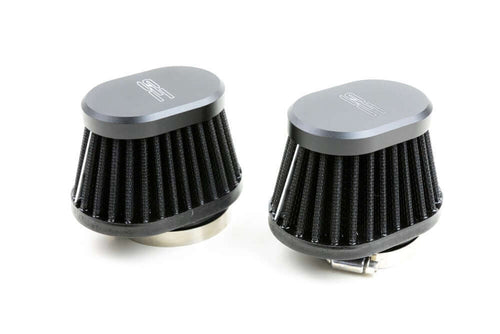
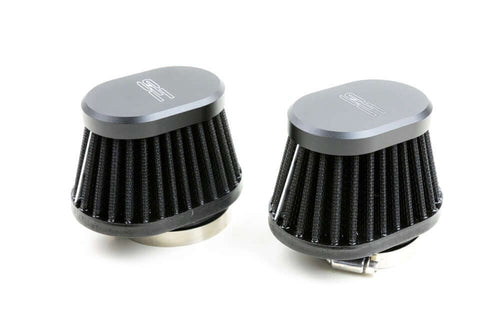
What I can say: Open filters definitely do not provide any power. Air filter box off, open filters on – then more or less 0.0 nothing happens, maybe 1 or 2 hp up or down. In many cases, you don't feel any difference on the road. We measure it, of course: The mixture becomes a bit leaner, but it is not completely off. With a CB 900 Bol d'Or, it's completely different – it simply doesn't run anymore with open filters, huge acceleration holes. The BMWs have relatively small head cross-sections in relation to the displacement and a high velocity in the intake duct, which makes it easier.
I cannot confirm that the vacuum piston in the Bing carburetor is disturbed. What I think I notice: The sensitivity for the float level becomes a bit higher.
- Float level too low: If you drive at full throttle for a longer time – main road, motorway, fifth gear, 5,000, 6,000 rpm – the engine sucks the float chamber empty. You get these little holes because fuel keeps running in, the engine pulls it away, and then it's too lean again.
- Float level too high: Because the carburetors are never perfectly level, a carburetor can sometimes overflow. That's why we always say: Turn off the fuel taps! If it happens while you are there, tap against the float chamber – usually a dirt particle is stuck. If it happens overnight, the tank has poured itself into the garage by morning.
Around 75% of our vehicles have open filters. Not because of power, but because people like the look – a reduced form, everything a bit freer.
Registering open air filters: What does the TÜV say?
Up to model year 1988 open filters are registered by the TÜV with us through power, stationary noise, and driving noise measurements – that is within the legal framework. From 1989 onwards new exhaust laws came into effect: Then, according to the law, you need an exhaust emission report, in the laboratory, like with the approval of a normal vehicle – 3,000, 4,000, 5,000 euros. Theoretically possible, practically no one does it. If customers order a motorcycle with registered filters from us, we therefore choose base vehicles up to 1988.
And the intake noise? Is measured by us. The filter sounds a bit wheezy, but that is subjective, it doesn't get really loud. I know of significantly louder intake noises from Japanese bikes with open filters or even funnels – I don't feel that with the BMWs. They pass the acceptance tests for stationary and driving noise without complaint.
Dust and rain: Paper filter vs. K&N
You can tap out the original paper filter – if it is slightly dirty. If it is really filthy, no longer. In terms of cost-effectiveness, the open filters have the advantage: You can wash them out more or less indefinitely and then soak them with special filter oil – for good filtering effect against dust and resistance to water. K&N is the best-known brand; we now also have other manufacturers in our range because we didn't like the chrome caps of the K&N.
Andreas and Klaus ask: What do the parts say when it's really pouring? Nothing. Sure, with the steam cleaner directly on it, it will probably get damp inside – haven't tried it. But I have driven very often in pouring rain, and the motorcycles are also sprayed off with the steam cleaner, without a bag over them. That has no effect, and I also have no feedback from customers that there were problems in the rain.
Engine overhaul BMW Boxer: Packages and process
You can bring everything: a motorcycle, an engine, individual parts, disassembled engines. We are currently doing at least 100 engines and even more cylinder heads – we know every screw, every cotter pin, every little spring by heart by now. We also accept projects that have been started, where the construction site became so big at some point that it means "I need help". The usual case: People convert it themselves, but don't trust themselves with the engine and transmission.
We have two standardized stages so that you have a price reference and can calculate your project – instead of "that can cost 2,000, 3,000 or 10,000 euros".
Stage 1: Engine overhaul light
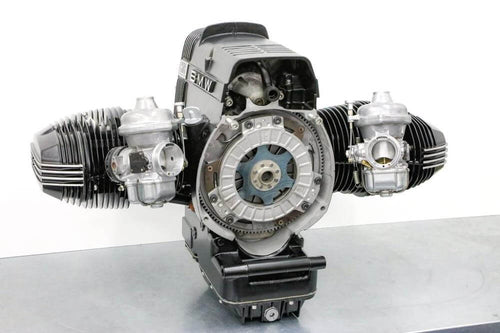
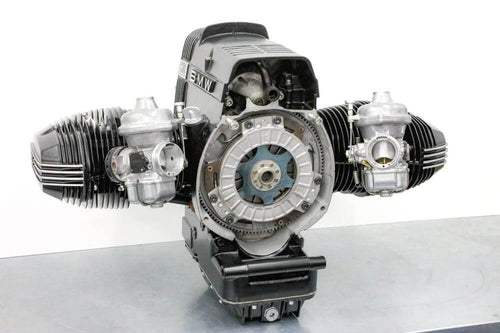
The engine doesn't have to come out. We remove the cylinders and cylinder heads. The cylinder heads are the Achilles' heel of the BMWs, if you can speak of one: We almost never have crankshaft damage, piston damage either – but 99% of the time, seat rings, valves, or valve guides are worn out, also due to the unleaded fuel history.
The connecting rods on the BMWs are bolted from the outside. We pull them and look at the connecting rod bearings. No guarantee, but if they look tip-top, the probability is good that the crankshaft bearings are also good. The cylinder head is always completely overhauled – only the aluminum body remains of the head: new valves, springs, cotter pins, seat rings, valve guides. Basically a new head.
And I think no one else does this: We install valve guides with valve stem seals like every motorcycle and car today. That doesn't necessarily reduce the wear of the guide, but it raises the limit: Even with a little more play, the engine doesn't immediately start to draw oil.
Stage 2: The big gun
Engine out, completely disassembled down to all individual parts. By default, it is blasted with ceramic beads so that the surface is closed and no dirt settles in open pores. Everything is included in the package price on our website: all bearings, timing chain, timing chain tensioner, the pin is caulked, cylinder heads done, new oil pump rotor, gaskets, oil filter – every part is handled.
If we find something else during disassembly, there is a separate cost estimate. We don't manage our customers' money: The customer knows what it costs and decides. We advise on what is necessary and what is not – with 35 years of experience in engine construction.
All threads are checked beforehand – we call this "cracking the thread": Torque wrench to a slightly higher value, all threads through. It would be annoying to do everything new, preferably even black coated, and then 25 threads are stripped.
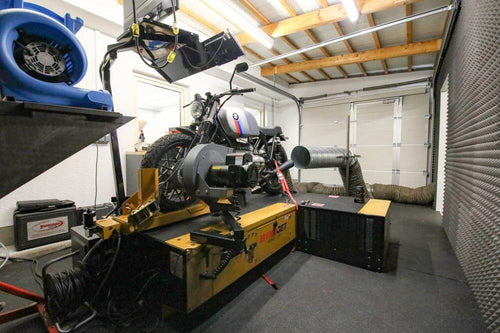
Cylinders: We can bore and hone old cast cylinders with oversized pistons. For worn Nikasil cylinders, there is a small step to a slightly larger piston; beyond that, other cylinders are usually put on. The package can be combined with tuning, for example a big-bore kit – then the cylinder reconditioning is omitted, and the package price is offset accordingly. Afterwards, it goes on the test bench if desired. Because that is a pure roller test bench, we have a test chassis for individual engines – such as racing engines from abroad.
Tire conversion: Load capacity, speed, rim width
Holger asks: How do you deal with tires that do not have the original values for speed and load class?
Through our cooperation with the TÜV, we may have other possibilities – but none that are illegitimate. The inspectors who come to us really have a plan. You might get some things realized that a normal customer cannot get done on the test track – but the bar is also set high, I often have to provide elaborate documentation.
- Speed: Is the motorcycle registered with 190 or 200 km/h and the tire only goes up to 180, you cannot ride it. Period. If it absolutely had to be, we reduced the speed via ignition curve or rev limiter in the last gear – with a 10 km/h buffer: Tire up to 180 means the motorcycle may only do 170.
- Load capacity: The TÜV makes no compromises there, and neither do we. I don't want a customer to have an accident because we misjudged something.
- Clearance: On the right, the tires come very close to the swingarm. We sometimes put 1, maybe 4 mm spacers underneath, then the issue is over. 4-inch rim, 160 tire, off-center spoked – that's not my world, it doesn't look proportional either. We go up to 140, and that fits proportionally well with the narrow motorcycle.
- Rim width: The 140 tires are actually intended for a slightly wider rim than the BMW rim (around 2.5 instead of 2.75 inches). A tire that is too wide on a rim that is too narrow often pulls itself like a roof with two edges. With the BMW rims, however, the tires we use up to 140 have a beautiful round contour.
Our standard sizes: Scrambler (Monolever) rear 140/80-18, front 110/80-18. Twinshock: front 110/80-19, rear usually 120/90-18. The higher cross-section looks more voluminous from the side – I find it chicer – and has more inherent damping.
Important: With other tires, the rolling circumference changes. With an original mechanical speedometer, the TÜV asks: "My dear friend, what happened to the speedometer?" Our conversions have adjustable speedometers. I take the motorcycle for a test ride and sign a driving test, every now and then the TÜV comes along.
Sending copies of registration documents or confirming something for other motorcycles? I don't do that. Exactly this one vehicle is always tested and registered. That is a basis of trust that I have built up over years – and believe me, they notice everything.
If the inspector says no
I understand if someone is asked for a certificate of no objection at another inspection center and gets annoyed. But the inspectors bear responsibility, that can go as far as criminal law. We know cases with twin-shock bobbers where the shock absorbers were bolted to the bracket of the rear frame – it is not designed for that, and depending on the rider, it tears off. Then you don't just hurt yourself, but also others. My advice: Respect that and drive to the next inspection center. There are plenty of inspectors who say: "Give me that thing, I'll ride it and register it for you." You just need a bit of tenacity.