Das Wichtigste in Kürze
- Paralever = one shock absorber, split swingarm with joint against driveshaft reaction
- Frame geometry like Monolever, but looks larger – good for tall riders
- Third-party fork: raw fork is just the beginning – axle, adapters, clamps are added
- Tank: Monolever tank (wider tunnel for the electrics), no Twinshock tank
- Align tank line with mounted rear before fixing
- 2-in-2 exhaust for Paralever possible as a workshop custom build
Today we have a Paralever model. The most frequently customized models are the Monolevers. A quick classification: First came the Twinshock with two shock absorbers, then the Monolever with one shock absorber, then the Paralever – also with one shock absorber. This is often confused: "Para" sounds like parallel, like two – but that's not true.
How to recognize a Paralever model
The big difference is the swingarm. It is split: the final drive and the driveshaft have a joint in the middle. BMW wanted to reduce the typical driveshaft reaction with this – that lifting of the rear end when accelerating.
Paralever is used less often as a base for customization because it looks more technical and has more volume. In terms of geometry, the frame is the same as the Monolever models, except for a few connections on the rear frame; the engine is also the same size. However, due to the rear end, the vehicle looks thicker and larger – which is why we like to use such chassis for taller customers. As standard, the Paralevers also have a wider fork, four-piston brake calipers, 17-inch at the rear and 18-inch at the front.
Roadster or Scrambler?
The question comes up again and again. I think they are very close to each other – a roadster with knobby tires is basically a scrambler. We built this bike at the customer's request; the customer came with a picture as a template: "I would like that direction."
The Öhlins fork – and what goes with it
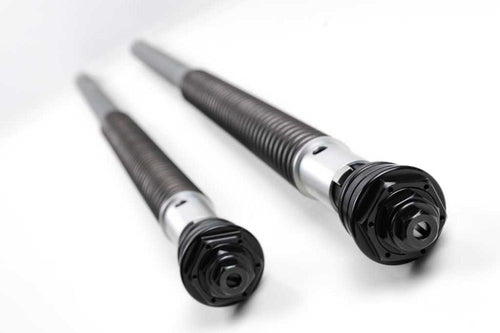
The customer placed a lot of value on the suspension. From the idea of an upside-down fork, we came to a classic Öhlins fork with 43 mm stanchions, quite conventional. The fork itself is still affordable in relative terms, as a raw fork, as I recall, somewhere between 2,500 and 2,800 euros. The big catch: you only have the two fork legs. No brake calipers, no brake caliper adapters, no axle, no triple clamps – a whole sum quickly adds up.
We try to take simple paths, for example, taking parts from an R nineT or another model so that we don't have to mill everything from scratch. You shouldn't underestimate the effort, though: we turned and milled the axle from solid material. Our triple clamps are installed – actually for 41 mm, but since there is enough material, we bored them out to 43 mm.
The tank: Monolever instead of Paralever
The Paralevers have this teardrop-shaped tank as standard. A matter of taste – I'm not a fan of it. We often adapt Monolever tanks or R65 tanks, which are similar to the R80 ST tank. The operation itself isn't that huge; the biggest challenge is actually getting the tanks.
- Caution when choosing a tank: From the outside, the Monolever tank looks like a Twinshock tank. If you turn it over, you see the much wider tunnel. The Paralevers have all the electrics laid out on one side – therefore, definitely take a Monolever tank. A Twinshock tank can only be squeezed in if you cut off parts of the frame. I wouldn't recommend it.
- Mounting: A small tube at the front, a bracket at the rear – this even comes from the BMW spare parts warehouse, standard on the Monolever models. We weld it on; if you don't have a welding machine, you can also bolt it on.
- Check the line beforehand: Before you fix it, put the rear frame and everything on and align it with the horizon. The adaptation can be shifted, and that changes the line of the tank. It's a shame if the rear is nice and the tank is sitting too high or too low.
Rear, license plate, and exhaust
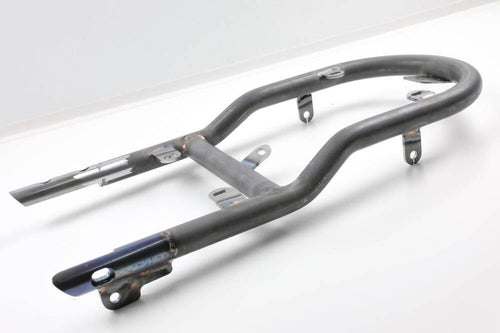
The request was for a self-supporting 1-person rear – shorter than our standard rears because no two people need to fit on it – with a short "seat pad" and mudguard. A license plate holder could have been put on the back, but it would have become much too flat. With the high-mounted 2-in-2 exhaust, it fits proportionally well into the lines of the vehicle.
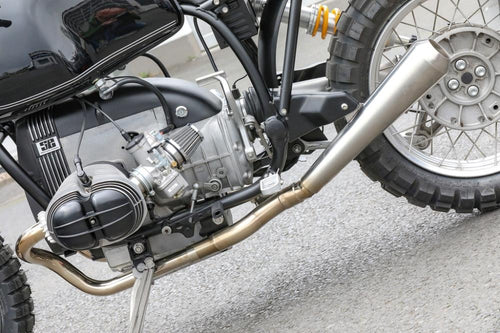
We have 2-in-1 systems for the Paralever models permanently in the shop. A 2-in-2 exhaust around the wide swingarm, without conflicting with the footrests, is tricky – but we can adapt and manufacture this in the workshop, and it is not exorbitantly more expensive than a standard system.
Used look and details
The customer wanted the frame sanded down, treated with fleece, and coated with clear lacquer – a used look. The engine also still has a few aluminum spots; nothing should look completely new. It's difficult for us to implement when someone says: restore completely, but not like new. What is a used look on an engine? Dirty, greasy? It develops over time anyway when the motorcycle is used.
Seat plate as a custom-made product, individually upholstered. Turn signals as a 3-in-1 solution.
Custom bike and TÜV
With turn signals, mirrors, and license plates, you are always moving between legality and what you like with custom bikes. What we notice: sometimes things are registered that are within the legal framework, and two years later another inspector says: "That's not possible at all." If it is within the legal basis, there is no reason not to approve it – sometimes you have to discuss that.
Especially with tire registrations, a huge fuss is sometimes made, with driving tests and everything. Fortunately, there are many good people at TÜV, Dekra, and Co. who say: I trust myself to do this and take responsibility for the customer driving safely with it. If someone makes a huge deal out of it, it might just be the wrong contact person, and you ask somewhere else.
All in all, a special vehicle that stands out. I don't find our standard portfolio – roadster, scrambler, bobber – boring, but the projects that challenge us are even more fun.