Das Wichtigste in Kürze
- Shock absorber mount moved approx. 2–3 cm forward
- Original twin-shock absorber: 330 mm – new: 350 mm
- Minimum frame length for 2-person operation (DE): 600 mm
- Remaining front suspension travel after adjustment: 135 mm
- Fender mount with slotted holes for radius adjustment
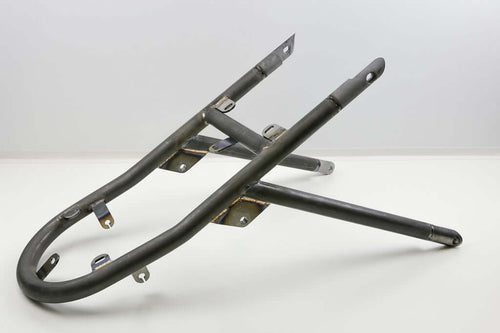
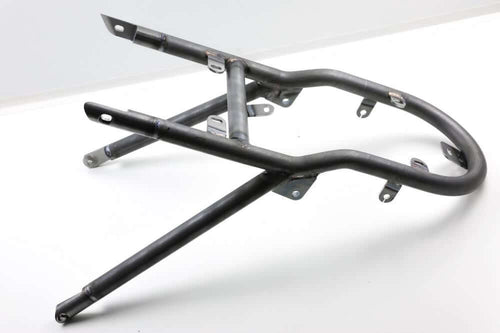
New rear frame for the twin-shock models. From the very beginning, we weren't entirely happy with the very upright position of the suspension elements. Up until now, we have always welded rear frames individually and welded them onto the frame – now we are turning this into a series product. Joining us is Arne, our metalworker, who basically welds all the frames here and takes responsibility for the special projects.
The challenge: Two-person operation and angled shock absorbers
We want to create a two-person rear frame while still getting the shock absorbers a bit more angled. Of course, we have to ensure the load-bearing capacity for a second person. We experimented a bit, then ran the whole thing through a simulation again to see: How far forward can we go while still maintaining the load-bearing capacity?
Result: We have moved about 2 to 3 cm further forward with the shock absorber mounting point – and we still have a sufficient support area for the rear frame. The support must, of course, remain in place. A shock absorber gives way, so it cannot serve as a support.
Series product means: It must fit at the customer's home
The difference: We are talking about a series product here. It is fitted to the vehicle, then the measurement is transferred to the template. And then it all has to be installable for the customer at home. They can't say, 'I'll just cut myself a new bracket, grind something on, and weld something on.' We can do that here in the workshop – and we often do completely individual things, lengthened, shortened, in any direction. But when someone gets it sent home, it has to fit.
New geometry = new shock absorber length
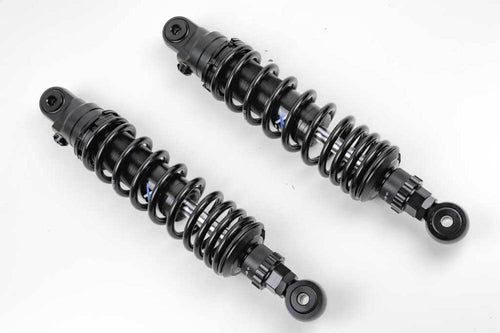
One issue that arises from this: The shock absorber length changes. The original BMW shock absorbers for the twin-shock models are 330 mm. Ours are length-adjustable, plus/minus 5 or 7 mm. Because the shock absorber is now more angled, the travel becomes longer – we are now at 350 mm. We can still manage that with our twin-shock suspension; we have extensions that we attach at the bottom to compensate for the extra range.
You have to keep this in mind with all conversions: If you are doing a bobber conversion, for example, and you angle the shock absorbers, the shock absorber lengths will no longer fit.
The rear fender: Radius on radius
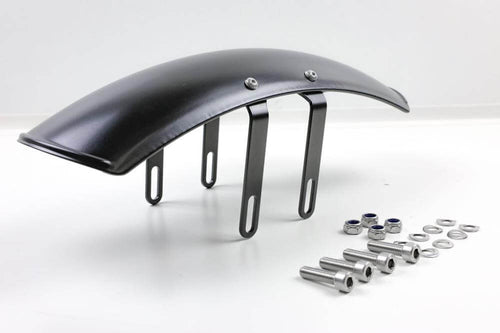
What I always find completely ugly: When such conversions are done and then the fender is just standing there somewhere, bolted on, and just ends somewhere. We pay meticulous attention to ensuring that the radius of the fender meets the radius of the tire.
The mudguards can be changed within a certain range – if you squeeze them together, they become narrower, and you can move them in both directions. This gives you the possibility to adjust the radius a bit. We have provided the mounts with slotted holes because the dimensions can change during adjustment and you still need to be able to screw it in.
Our tip if you are doing such a build at home: Put the fender in, get yourself a little chair and a glass of wine or a beer, sit down in front of it, and see if it really fits. Put a lot of effort into it at the beginning – it will definitely pay off later when you have beautiful, consistent radii.
By the way, the frame length is designed for two people. The minimum dimension in Germany for two-person operation is 600 mm – we have pushed exactly to that limit because we want to keep the whole thing as short as possible.
The front: A straight, horizontal line
The motorcycle is an R90/6, an old two-valve engine, a complete conversion as a customer order. Insiders can already tell from the fork that it doesn't belong: The fork is from a Paralever model, and the Paralever forks are simply longer in overall dimension. We had already pushed them through by 50 mm, but the motorcycle still stood too high at the front – with 155 mm of suspension travel.
So we simulated: Push the fork through further, take a look, until there is really a straight horizontal line on the motorcycle. Then we know how much to shorten the fork. Important: After setting it down, let it compress once; as a rule, it settles a bit more.
In the end, it sits nicely in line, and we still have 135 mm of suspension travel effectively left at the bottom. That is still a healthy amount with which you can achieve great handling – today's motorcycles have 115, 120 mm.
Our advice: Let it have an effect
If you look too closely and are always just in one area, it happens quickly that you don't have the overall view of the motorcycle. Then everything is finished, you call your buddies – and one says: 'The radius doesn't fit at all, it stands so high at the front.' And the whole thing starts all over again. So: Look at it from all sides, maybe leave it for a day. We often do that too – and often we say a day or two later: 'No, come on, let's change that.'